Winter Tree Care Tips for Duluth Homeowners
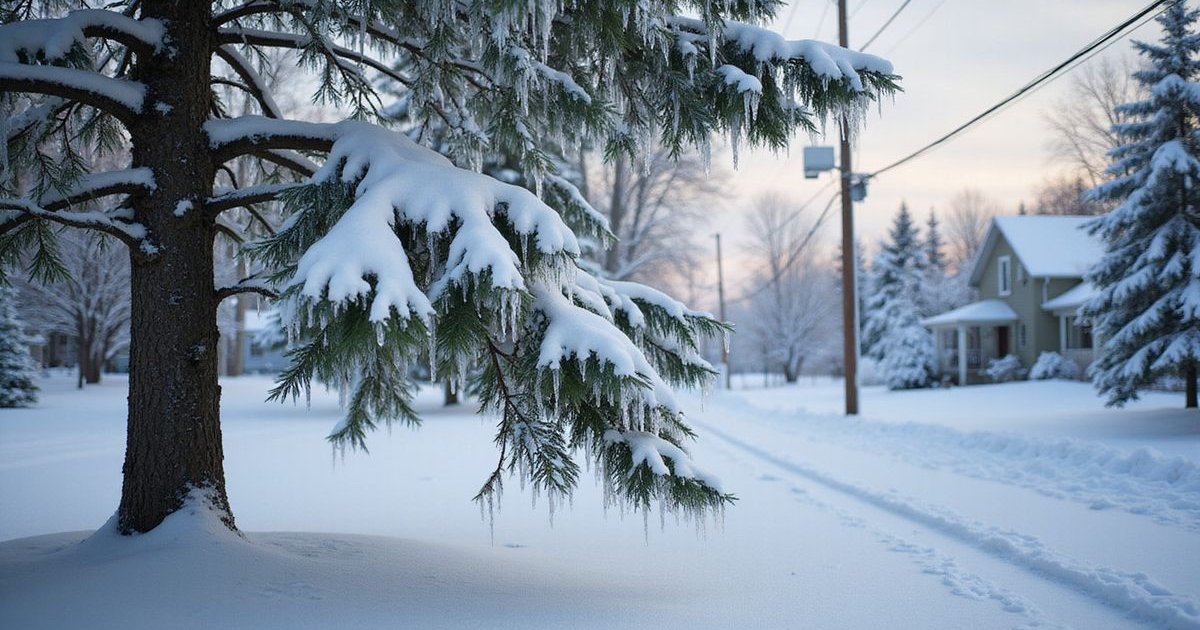
Winter in Duluth is an endurance test for your landscape.
With January temperatures often struggling to break 10 degrees Fahrenheit and wind chills that can plummet to minus 30, our local trees face challenges unknown to much of the country.
We see the effects of this harsh climate firsthand every spring.
The combination of steep Hillside terrain and lake-effect moisture creates a unique environment where tree care is less about aesthetics and more about survival.
As an ISA Certified Arborist team serving this region, we have found that proactive maintenance during the dormant season is the single most effective way to protect your investment.
A few strategic moves in late fall can save you thousands of dollars in removal or repair costs when the snow melts.
Here is the strategy we use to keep Duluth’s urban forest standing strong.
Prepare Before the Ground Freezes
Successful winter survival begins long before the first major blizzard hits the Twin Ports.
The work you do in late October and November sets the biological stage for how well a tree handles deep dormancy.
Late-Fall Watering
Dehydration is a silent killer in our climate.
We often see trees die not from the cold itself, but from desiccation.
Trees continue to lose moisture through their bark and twigs even when they look asleep.
If the root zone is dry when the ground freezes, the tree has no way to replenish that lost water until the spring thaw.
The Pro Tip: Give your trees a heavy, deep soaking until the ground actually freezes, which typically happens here in early December.
Focus heavily on evergreens like spruce, pine, and arborvitae.
These species retain their needles and lose water at a higher rate throughout the winter.
A general rule of thumb is to apply 10 gallons of water for every inch of the tree’s trunk diameter.
Mulch for Root Insulation
Soil temperature fluctuations can be just as damaging as air temperature drops.
We recommend applying a 3-to-4-inch layer of organic mulch to act as a thermal blanket for the root system.
Wood chips or shredded bark work best to moderate soil temperatures and retain that critical late-fall moisture.
Correct Application: Create a “donut” shape, not a “volcano.”
Pile the mulch around the base but keep it pulled back 3 to 6 inches from the actual trunk.
Piling mulch directly against the bark promotes rot and invites rodents to nest right against the tree, which can lead to fatal chewing damage.
Winter Pruning Strategy
Late fall and winter are actually the premier times for tree trimming and pruning in Minnesota.
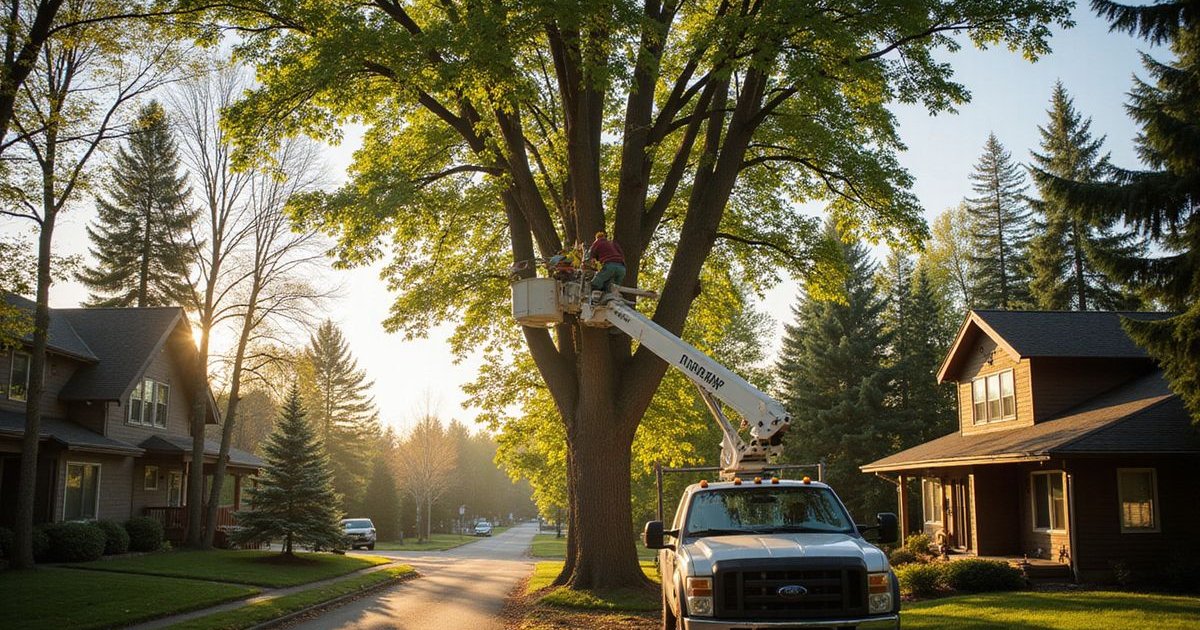
We schedule the majority of our structural pruning between November and March for biological and safety reasons.
Why Winter Pruning Works Best:
- Disease Prevention: The deadly Oak Wilt fungus is active from April through July. Pruning oaks in winter eliminates the risk of infection.
- Structure Visibility: Without leaves, we can clearly see crossing branches, structural defects, and weak unions.
- Hardened Ground: Frozen soil allows us to access trees with equipment without compacting the soil or tearing up your lawn.
Managing Snow and Ice Loads
Duluth snowfall averages over 80 inches annually.
That weight breaks countless branches every year, but how you react to the snow matters just as much as the snow itself.
Snow Load on Evergreens
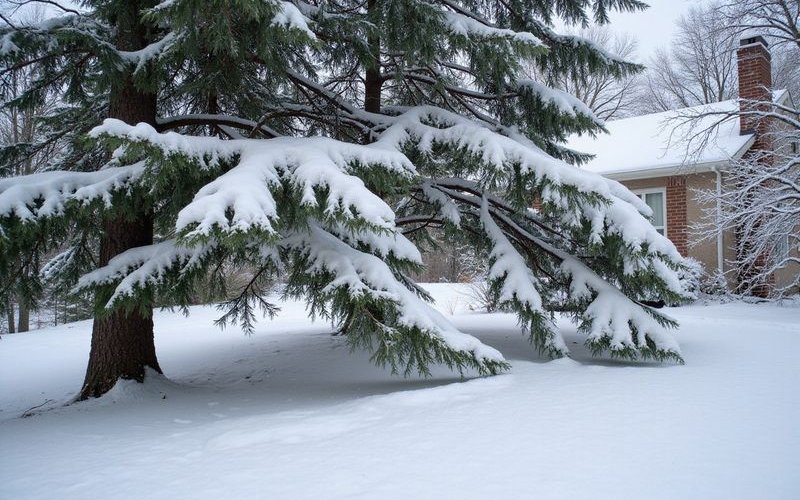
Heavy, wet snow can bend flexible evergreen branches to the breaking point.
We advise homeowners to be extremely gentle when helping their trees.
The Safe Removal Method: Use a soft broom to brush snow off lower branches, sweeping in an upward motion.
Start at the bottom and work your way up.
If you start at the top, the snow you knock off will fall onto the lower branches, adding weight and potentially snapping them.
What to Avoid: Do not shake the tree.
Wood becomes incredibly brittle in sub-zero temperatures.
A violent shake that would be harmless in summer can snap a frozen branch instantly.
If the branches are coated in ice, leave them alone.
Attempting to break the ice will almost certainly damage the bark or the wood underneath.
Protecting Multi-Stem Trees
Arborvitae and columnar junipers are prone to “splaying” under snow load.
We see this frequently in neighborhoods like Congdon Park where these trees are used for privacy screens.
Heavy snow gets lodged in the center of the plant and pushes the stems apart, permanently ruining the upright shape.
The Fix: Wrap these trees loosely with burlap or heavy twine.
Start at the base and spiral up to the top, securing the stems together so they support one another.
Remove this binding as soon as the snow melts in spring to prevent fungal issues.
Ice Storm Response
Freezing rain is a common occurrence near Lake Superior.
We urge you to prioritize safety over tree health immediately following an ice storm.
Stay away from ice-loaded trees until the melt occurs.
A branch the size of your wrist can weigh hundreds of pounds when encased in ice.
If a limb is threatening a power line or hanging precariously over a walkway, call a professional immediately rather than attempting DIY removal on slippery ground.
Protecting Against Frost Cracks
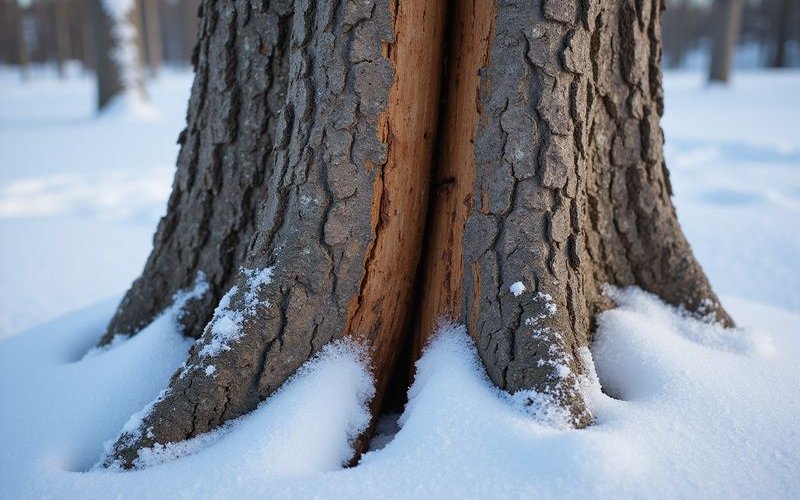
Rapid temperature swings cause vertical splits in tree trunks, known as “sunscald” or frost cracks.
We see this most often on the south or southwest side of trees.
On a sunny February day, the dark bark absorbs heat and expands.
When the sun sets and temperatures drop rapidly, the bark contracts faster than the wood beneath, causing it to split with a loud crack.
High-Risk Species
Thin-barked trees are the most susceptible to this thermal shock.
Common Victims in Duluth:
- Maples: Specifically Norway, Red, and Sugar maples.
- Fruit Trees: Apple, crabapple, and cherry trees.
- Lindens: Young trees are particularly vulnerable.
Prevention Strategies
Tree Wrap: Apply a white tree guard or paper tree wrap in late fall.
The white color reflects the sunlight, keeping the bark temperature closer to the air temperature.
Wrap from the ground up to the first major branch.
Removal is Key: Take the wrap off in early April.
Leaving it on during the growing season can trap moisture and harbor insects.
Winter Wildlife Damage
Hungry wildlife can destroy a young tree in a single night.
We encounter significant damage from voles, rabbits, and deer when deep snow eliminates their other food sources.
Rodent Protection
Meadow mice and voles tunnel under the snow and chew on the bark at the base of trees.
If they chew all the way around, they girdle the tree, cutting off the flow of nutrients.
The Hardware Cloth Solution: Plastic spiral guards are okay, but 1/4-inch mesh hardware cloth is better.
Form a cylinder around the trunk that extends 2 to 3 inches below the soil line and at least 24 inches above the expected snow line.
This creates a physical barrier that teeth cannot penetrate.
Deer Deterrents
Deer in the Spirit Mountain and Hartley Park areas are aggressive browsers.
We recommend physical barriers as the only 100% effective method.
Fencing or rigid mesh cages around individual trees work best.
If fencing is not an option, use a reputable repellent spray like Plantskydd.
Apply it on a dry day above freezing temperatures so it adheres to the buds and twigs.
Road Salt and De-Icing Damage
Salt spray from busy streets is toxic to many tree species.
We frequently diagnose “salt burn” in spring, characterized by brown needles on the street-facing side of evergreens or dieback on deciduous trees.
Sodium chloride prevents roots from absorbing water, essentially causing drought stress even in moist soil.
Mitigation and Species Selection
Use Alternatives: Switch to calcium magnesium acetate (CMA) or simply use sand for traction on your own property.
Soil Remediation: If your trees are in a high-salt zone, flush the soil with water in early spring to leach out the sodium.
Applying gypsum can also help displace sodium in the soil profile.
Choose the Right Tree: When planting near a roadway, selecting a salt-tolerant species is the best long-term defense.
| Salt-Tolerant Species | Salt-Sensitive Species (Avoid near roads) |
|---|---|
| Hackberry | White Pine |
| Ginkgo (Male) | Red Pine |
| Honey Locust | Sugar Maple |
| Kentucky Coffeetree | Basswood (Linden) |
Winter Storm Damage: When to Act
Assessing damage after a storm requires a calm approach.
We advise clients to look for specific hazards before worrying about cosmetics.
Emergency Situations:
- Broken branches hanging over roofs, cars, or driveways (called “widowmakers”).
- Split trunks or major branch unions.
- Trees leaning toward a structure.
Non-Emergency Issues:
- Small broken twigs.
- Minor branch damage in the lower canopy.
- Loss of a few small limbs.
For dangerous work, Northshore Tree Service provides specialized emergency storm damage response.
Our crews have the gear and training to work safely on ice-covered trees and steep slopes. For trees with structural weaknesses that aren’t yet an emergency, cabling and bracing can add support before winter storms test them.
Plan Ahead for Healthy Trees
Winter care is really a year-round commitment.
Trees that enter winter with strong energy reserves are far more likely to bounce back in spring.
We encourage you to look at tree care as an ongoing partnership with your landscape.
Regular inspections allow us to spot weak forks or decay pockets before a blizzard tests them.
If you are worried about how your trees will handle the coming cold, contact Northshore Tree Service.
We serve Duluth, Hermantown, Proctor, and the North Shore with complete tree health and disease treatment plans.
Let us help you ensure your trees survive the frost and thrive when the warm weather finally returns.
Need Professional Tree Service?
Call our ISA Certified Arborist for a free estimate. Serving Duluth, MN and the North Shore.
Call (218) 555-0391