What to Expect from a Stump Grinding Service (Process & Cost)
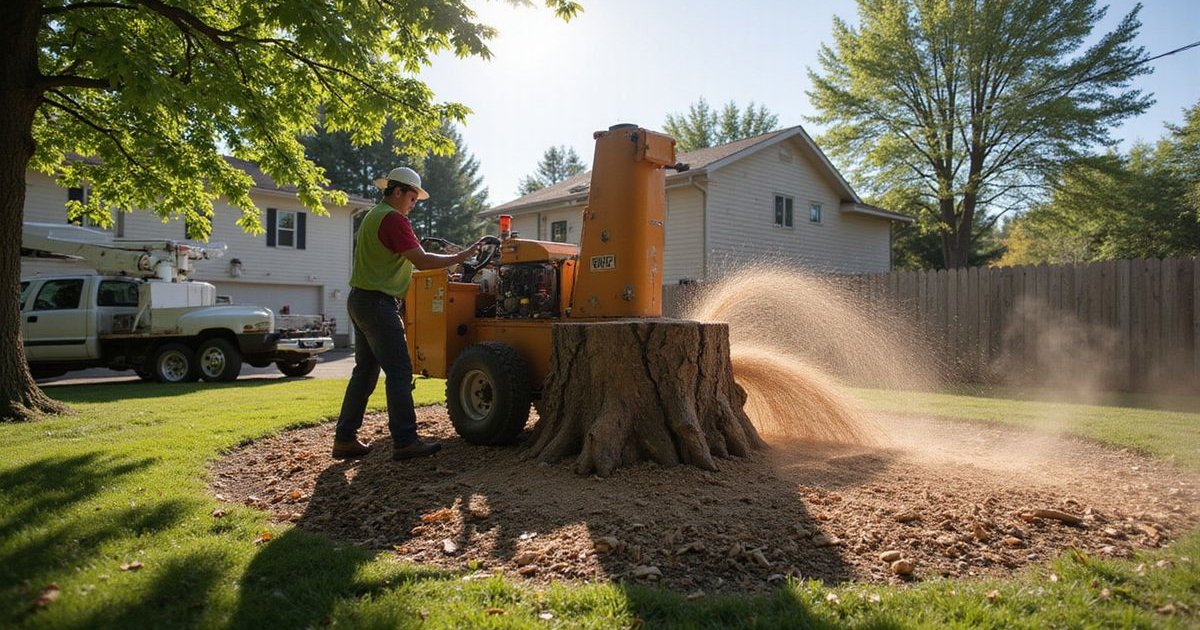
If you have recently had a tree removed from your Duluth property, you are likely staring at the remaining stump and wondering what comes next.
Stump grinding is generally the most efficient method for handling these leftovers, but the process involves more than just chewing up wood.
Understanding the mechanics and logistics helps you know exactly what to expect when you schedule a stump grinding service.
As an ISA Certified Arborist serving the Duluth area and Minnesota’s North Shore, our team has ground thousands of stumps across every type of terrain.
We have seen it all, from flat lakeside lots to steep hillside properties overlooking Lake Superior.
This guide covers exactly what happens before, during, and after a professional stump grinding service.
Why Stump Grinding Is the Preferred Method
Understanding why we prioritize grinding over extraction helps clarify the value of this service.
Duluth’s terrain presents unique challenges that make full removal difficult.
Many properties here sit on rocky soil with significant elevation changes that complicate excavation.
Our native birch, maple, spruce, and pine trees also develop root systems that resist simple extraction.
Minimizing Impact on Your Landscape
Stump extraction involves digging out the entire root ball, which often leaves a massive crater in your yard.
Grinding mechanically chips away the stump below ground level without disturbing the surrounding soil structure.
This approach preserves the integrity of nearby retaining walls, driveways, and underground utilities.
Pest Prevention and Safety
Leaving a stump to rot naturally can invite unwanted guests.
Carpenter ants and termites are drawn to decaying wood and can eventually migrate to your home.
Grinding the stump eliminates this food source and removes a significant tripping hazard from your lawn.
For homeowners in neighborhoods like Congdon or Piedmont Heights, grinding is often the only realistic option due to limited equipment access.
The Pre-Service Assessment
Every professional job begins with a thorough on-site evaluation.
We look for specific factors that dictate the price and the equipment needed.
Stump Size and Species Analysis
A 12-inch birch stump processes very differently than a 36-inch red oak.
Hardwoods like oak and maple are significantly denser, requiring more time and sharp teeth to grind effectively.
Softwoods like pine grind faster but create a larger volume of fluffy debris that takes more time to clean up.
Utility Location and Safety (Call 811)
Safety is our absolute priority before any machine touches the ground.
Federal and state laws require notifying Gopher State One Call (811) to mark underground public utilities.
We verify the location of gas, electric, and communication lines, as grinding teeth can easily sever shallow cables.
Access and Terrain Evaluation
We assess how close the stump is to structures, fences, and other trees.
Many Duluth stumps sit on slopes or near retaining walls that require careful equipment positioning.
Our team also checks gate widths, as standard backyard gates can sometimes block larger machinery.
Root Flare Inspection
We evaluate the root flare and surface roots to determine the total grinding area.
Maples and spruces common in our region often have extensive surface roots that require attention beyond the main stump.
Equipment Used for Stump Grinding
Professional companies use specialized machines designed for specific environments.
We rely on distinct types of grinders to handle everything from backyard gates to massive commercial lots.
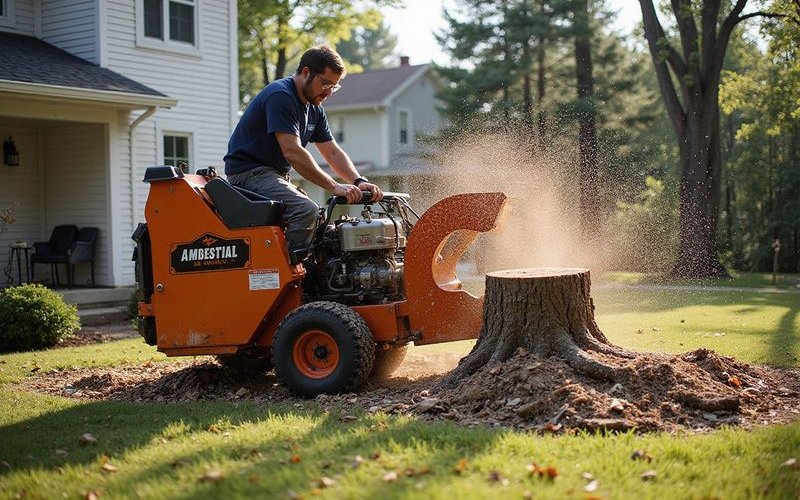
Compact Walk-Behind Grinders
These units are designed for tight spaces and fenced yards.
They fit through standard 36-inch gates, making them perfect for Duluth’s older neighborhoods like Lincoln Park.
While smaller, they still pack enough power to handle significant stumps in confined areas.
Self-Propelled Track Grinders
We often use machines like the Vermeer SC30TX for their balance of power and low impact.
Tracks distribute the machine’s weight more evenly than wheels, reducing the risk of ruts in your lawn.
These mid-size units handle most residential stumps efficiently and can climb moderate slopes.
Large Tow-Behind or Commercial Grinders
These heavy-duty machines are reserved for the largest stumps or open commercial projects.
They can process stumps several feet in diameter in a fraction of the time it takes smaller units.
We occasionally deploy these for mature elm and oak trees that have been growing for decades.
Equipment Comparison Guide
| Feature | Walk-Behind | Self-Propelled Track | Large Commercial |
|---|---|---|---|
| Best For | Fenced backyards, narrow gates | Sloped yards, medium stumps | Open fields, massive stumps |
| Lawn Impact | Low | Very Low (Low PSI) | High (Requires mats) |
| Gate Access | 29” - 35” width | 35” - 40” width | Requires open access |
| Speed | Slower | Fast | Very Fast |
The Grinding Process Step by Step
Knowing the workflow helps you stay safe and understand what the crew is doing on your property.
Step 1: Site Preparation and Safety Setup
The crew clears the area around the stump to remove rocks, metal, or loose materials.
High-speed grinding wheels can turn a small stone into a dangerous projectile.
We also place protective screens or plywood shields if the stump is near a window or parked car to block flying debris.
Step 2: Strategic Equipment Positioning
The operator positions the grinder at the edge of the stump.
On flat ground, this is a straightforward process.
Hillside properties require us to anchor the machine securely to ensure stability during operation.
Step 3: The Grinding Operation
The operator engages the cutting wheel and moves it in a sweeping side-to-side motion.
Carbide-tipped teeth chew through the wood, converting it into small chips.
We work methodically from one side to the other, lowering the cutting depth with each pass.
Most stumps are ground to a depth of 6 to 12 inches below grade level.
This depth is sufficient for planting grass or laying sod.
If you plan to replant a tree in the exact same spot, tell us beforehand so we can grind significantly deeper, often up to 18 inches.
Step 4: Chasing Surface Roots
The operator addresses visible surface roots after the main stump is gone.
These roots can damage mower blades and create tripping hazards if left behind.
We typically grind these roots out to 12 to 18 inches from the stump edge, or further if requested.
Step 5: Cleanup and Hole Filling
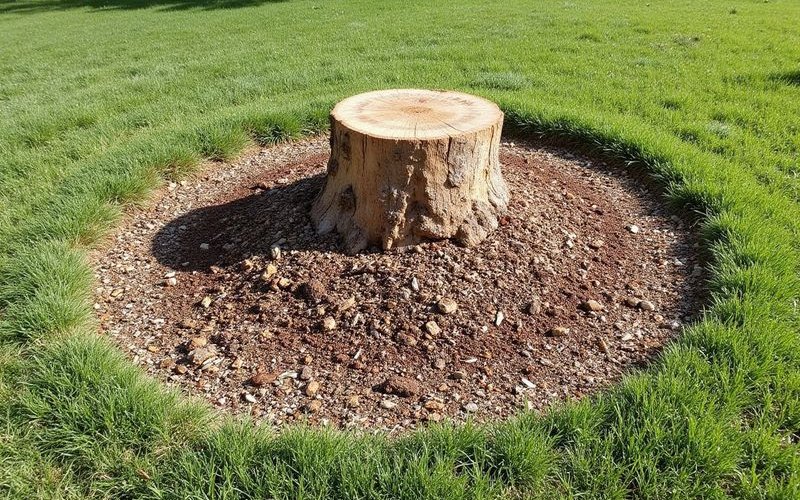
Grinding leaves a pile of wood chips mixed with soil that is about 30% larger in volume than the original stump.
The crew rakes these chips back into the hole to fill the depression.
Depending on your agreement, excess chips can be hauled away or left for you to use as mulch in other garden beds.
How Long Does Stump Grinding Take?
Time on site varies based on wood density and physical access.
Here are the general timeframes we see for jobs in the Duluth area.
- Small stumps (under 12 inches): 15 to 30 minutes.
- Medium stumps (12 to 24 inches): 30 to 60 minutes.
- Large stumps (24 to 36 inches): 1 to 2 hours.
- Very large stumps (over 36 inches): 2 to 4 hours.
These estimates include setup and basic cleanup.
Hardwood species like oak take longer to process than softer pines.
Processing multiple stumps on one property is always faster per stump since the setup is done once.
Stump Grinding Cost Factors
Pricing is usually calculated per inch of stump diameter.
Understanding these variables helps you budget accurately.
Stump Diameter Measurements
We measure the stump at the widest point where it touches the ground, not across the top cut.
National averages for 2025 typically range between $3 and $6 per inch of diameter.
Larger stumps may have a lower price-per-inch, while smaller ones might trigger a minimum service fee.
Volume Discounts
We offer better rates when grinding multiple stumps during a single visit.
Travel and setup utilize a significant portion of our time.
Grouping stumps from a recent clearing project saves you money compared to scheduling separate visits.
Access Difficulty Surcharges
Stumps located on steep slopes or behind narrow retaining walls increase labor time.
If we cannot get a machine to the stump and must use portable equipment, the price will reflect the manual labor involved.
Root Chasing and Cleanup
Extensive surface root grinding increases the total square footage of the work area.
Hauling away the wood chips is also a separate service from the grinding itself.
Disposal fees cover the labor of loading the chips and the cost of dumping them at a green waste facility.
Most residential jobs in our area fall between $150 and $500 total, with the average medium stump costing around $250.
What Stump Grinding Does Not Do
Setting realistic expectations prevents surprise down the road.
Grinding removes the visible stump, but it does not erase the root system entirely.
Root Decomposition Timeline
The remaining roots underground will decompose naturally over time.
In our cold climate, this process can take 5 to 10 years depending on soil moisture.
Soil Settling and Mushrooms
You may notice slight ground settling as the underground roots break down over the years.
Mushrooms often sprout from these decaying roots, which is a sign of healthy soil biology.
Contractors should account for this gradual settling if you plan to pour concrete over the area.
Preparing Your Property for Service
You can help ensure the job goes smoothly by taking a few simple steps.
Clear the Work Zone
Remove garden lights, potted plants, and hoses within 10 feet of the stump.
The spray of wood chips is powerful and can damage fragile items instantly.
Protect Vehicles and Windows
Move cars at least 20 feet away from the work area or into a garage.
Flying debris can chip paint or crack glass even with protective screens in place.
Mark Invisible Hazards
Flag any sprinkler heads, invisible dog fences, or private lighting cables.
We call 811 for public utilities, but private lines are your responsibility to identify.
Ensure Clear Access
Unlock side gates and clear a path from the driveway to the backyard.
Coordinate with neighbors if we need to cross a shared driveway to access the stump.
After the Grinding Is Complete
You will want to plan for site restoration once the machine is gone.
Fresh wood chips can rob the soil of nitrogen as they decompose, which may yellow new grass.
We recommend removing most of the chips and replacing them with nitrogen-rich topsoil before seeding.
For detailed guidance on post-grinding restoration, check out our guide on what to do after stump grinding.
If you are still weighing your options, our article on whether to leave or grind a stump breaks down the pros and cons.
Schedule Your Stump Grinding Service
Northshore Tree Service provides professional stump grinding throughout Duluth, Hermantown, and Proctor.
We bring expert knowledge and professional-grade equipment to every job to ensure clean, safe results.
Whether you have a single stump from a recent tree removal or a yard full of old hazards, we are ready to help.
Contact us for a free on-site estimate and see why Duluth homeowners trust us for reliable service.
Need Professional Tree Service?
Call our ISA Certified Arborist for a free estimate. Serving Duluth, MN and the North Shore.
Call (218) 555-0391