7 Signs Your Tree Needs to Be Removed Before It's Too Late
7 Signs Your Tree Needs to Be Removed Before It becomes a liability is a concern every homeowner eventually faces. We know that trees are the defining feature of many Duluth properties. They buffer the winds off Lake Superior, increase property value by up to 15%, and provide essential shade during our humid summers.
Our team has spent years caring for the urban forest from Park Point to Piedmont Heights. This experience has taught us that while trees are resilient, they are not immortal. Structural defects, aggressive decay, and storm damage can quickly transform a prized landscape asset into a significant threat to your home.
Recognizing the difference between a manageable issue and an immediate danger is critical. We are going to outline the specific indicators that suggest a tree is beyond saving and explain exactly what you should look for.
1. Large Dead Branches in the Upper Crown
Spotting deadwood is often the first clue that a tree is in trouble. We always check the upper canopy first because that is where the tree’s energy reserves usually fail initially. Small twigs dying off is a natural process called self-pruning.
The situation changes when you see larger limbs losing life. Branches that are three to four inches in diameter or larger are significant structural components. If these limbs are dead, they become “widowmakers.” This term is not an exaggeration. Dead oak or maple branches of this size can weigh over 100 pounds and snap without warning, even on calm days.
Assessing the Danger Level:
- The 25% Rule: If more than 25% of the canopy is dead or declining, the tree’s vascular system is likely failing.
- The “Hanger” Check: Look for detached branches that are caught in the canopy. These are immediate drop hazards.
- Seasonal Timing: Check your trees in late June. If large sections remain bare while the rest of the tree has leafed out, those branches are dead.
Our arborists often recommend selective pruning if the deadwood is limited to a few branches. However, widespread dieback usually indicates a systemic issue that pruning cannot fix.
2. Trunk Decay and Fungal Growth
Internal decay is deceptively dangerous because it hides behind the bark. We often find that a tree looks healthy on the outside while the heartwood—the structural column supporting the tree’s weight—is turning to mush.
Mushrooms are the tell-tale sign that this process is happening. Fungal conks growing on the trunk or root flares are the reproductive structures of a fungus that has already been eating the wood inside for years. In the Duluth area, we specifically look for Ganoderma (Artist’s Conk) and Inonotus obliquus (Chaga) on birch trees.
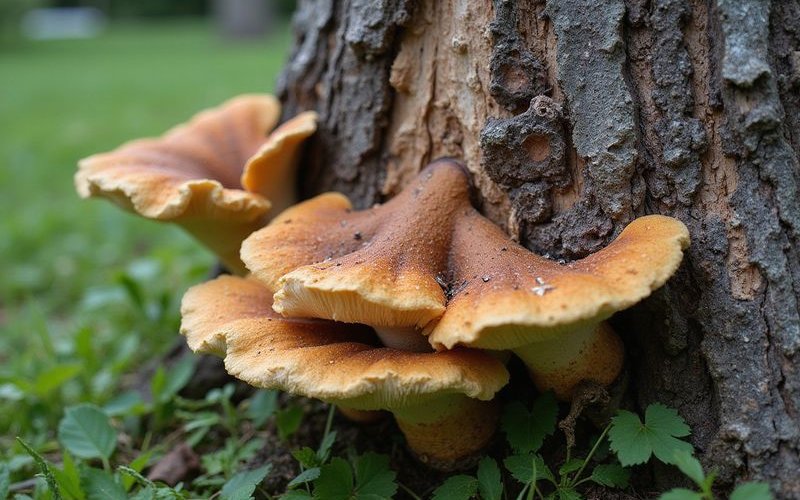
Common Duluth Decay Indicators:
| Sign | What It Means | Risk Level |
|---|---|---|
| shelf Fungi (Conks) | Advanced internal rot | High |
| Soft/Spongy Wood | Wood density is compromised | Severe |
| Cavities/Holes | Structural weakness | Moderate to High |
| Carpenter Ants | Nesting in already soft, decaying wood | Moderate |
If you see these signs, the “shell” of healthy wood may be too thin to support the tree. Our standard safety check involves drilling resistance testing to measure exactly how much sound wood remains.
3. Significant Lean That Has Changed Recently
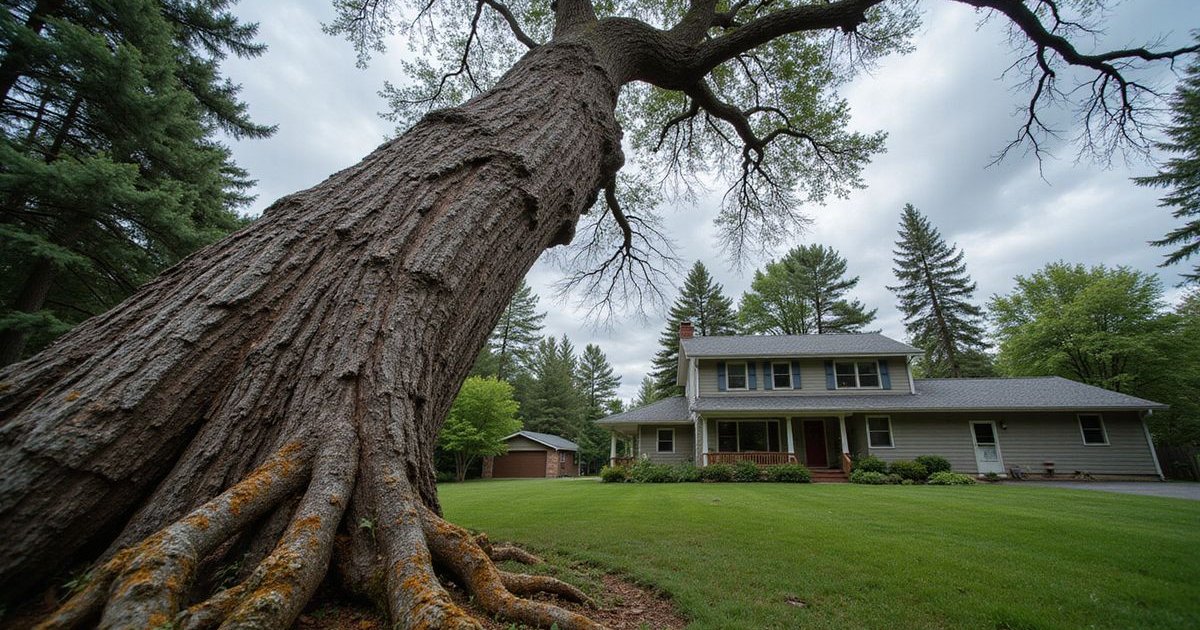
Most trees do not grow perfectly straight. We see countless trees on Duluth’s hillsides that have a natural list toward the light. A consistent, long-term lean is generally safe because the tree has built “reaction wood” to reinforce itself.
A lean that changes is a different story. If your tree has recently tilted, it means the root plate is lifting or the soil has failed. This is a common emergency in our region due to the heavy red clay soil. When this clay becomes saturated during spring thaw or heavy rains, it loses cohesion and allows roots to slip.
The 15-Degree Threshold
- Slight Lean (less than 15°): Usually monitorable if stable.
- Severe Lean (greater than 15°): Often requires removal, especially if new.
- Soil Heaving: Look at the base of the tree on the side opposite the lean. If the soil is cracked or lifted, the roots are actively pulling out of the ground.
You should consider this an emergency. Keep your family away from the fall zone and contact an emergency tree service provider immediately.
4. Root Damage or Decay
Roots are responsible for 100% of a tree’s water uptake and structural stability. We find that root damage is the number one cause of tree failure in urban environments. Since you cannot see the roots, you have to look for secondary symptoms.
Construction is a frequent culprit. Excavation for a driveway, utility line, or patio within the Critical Root Zone (CRZ) often severs major anchor roots. The CRZ is roughly one foot of radius for every inch of trunk diameter. If a 20-inch wide maple has a trench dug within 10 feet of its trunk, it has likely lost 40% of its support system.
Symptoms of Root Failure:
- Canopy Dieback: Thinning leaves at the very top of the tree.
- Undersized Leaves: Foliage that is noticeably smaller than previous years.
- Fungal Growth: Mushrooms growing in the soil near the base, specifically Armillaria (Honey Fungus).
- Road Salt Damage: Dieback on the street-facing side of the tree.
Trees with compromised roots can remain standing for a few years before falling unexpectedly. We recommend an annual assessment for any tree that has experienced nearby construction within the last five years.
5. Bark Splitting and Cankers
Your tree’s bark serves the same purpose as your skin. It protects the sensitive inner layers from infection and injury. When we see deep vertical cracks, it indicates a structural failure or extreme stress.
Frost cracks are incredibly common in Minnesota. These occur when temperatures plummet rapidly, causing the outer wood to shrink faster than the inner heartwood. While a single frost crack on a maple might heal, multiple cracks suggest the tree is struggling to maintain its integrity.
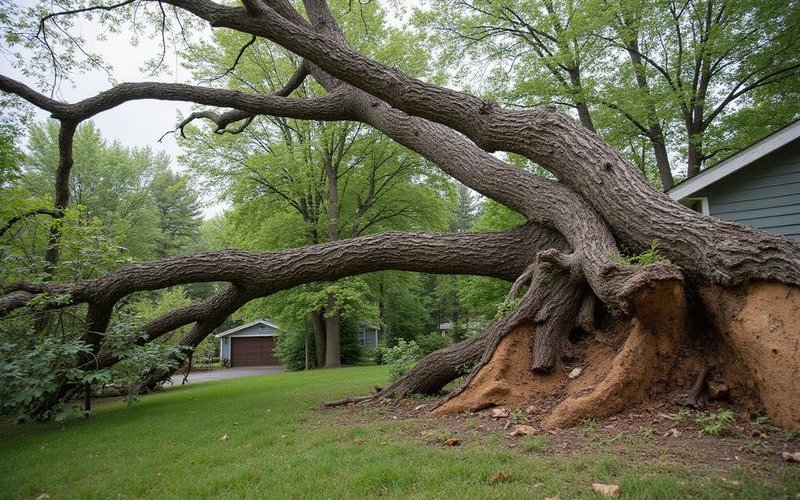
Identifying Dangerous Splits:
- Co-dominant Stems: Two trunks growing from the same base often have “included bark” between them. This weak union is prone to splitting in high winds.
- Cankers: These are sunken, dead patches of bark caused by bacterial or fungal infection. If a canker covers more than 50% of the trunk’s circumference, the tree is structurally unsound.
- Deep Fissures: If you can insert a pencil deep into a crack, the split likely extends into the heartwood.
Species like mountain ash and aspen are particularly prone to canker diseases in our climate. We check these trees rigorously because the wood beneath a canker is often brittle and weak.
6. The Tree Is the Wrong Species in the Wrong Place
Sometimes the tree is healthy, but the location is fatal. We frequently remove trees that were planted decades ago without foresight regarding their mature size. A blue spruce planted three feet from a foundation will eventually damage the siding, roof, and drainage system.
This “wrong tree, wrong place” scenario creates constant conflicts with infrastructure. We often see willow roots invading sewer laterals or cottonwoods dropping heavy limbs on garages.
Target Distance Guidelines:
| Tree Size Class | Minimum Distance from Home | Examples |
|---|---|---|
| Small (under 25 ft) | 8-10 feet | Crabapple, Serviceberry |
| Medium (25-50 ft) | 15-20 feet | Mountain Ash, Ironwood |
| Large (over 50 ft) | 20+ feet | Sugar Maple, Oak, Pine |
Removing these trees is often the only way to protect your property. Once the removal is complete, you can replant with a species that fits the available space. Our team can help you select a tree that provides the beauty you want without the risk to your foundation.
7. Severe Storm Damage
Duluth weather is unforgiving. We see first-hand how Lake Superior gales and heavy ice loads can devastate even healthy trees. A tree that has survived a storm isn’t necessarily safe.
Specific types of damage make recovery impossible. If a tree loses more than 50% of its live canopy in a single event, it will likely starve due to a lack of photosynthesis before it can regrow.
The “Red Flag” Damage List:
- Split Trunks: Any vertical crack running down the main stem.
- Broken Tops: If the main leader snaps off, the tree will never regain its natural form and will be prone to rot.
- Tipped Roots: If the root ball has lifted even slightly, the tree is unstable.
We advise homeowners to use our storm damage assessment guide immediately after severe weather. If you are unsure, stay clear. Storm-damaged trees are often under immense tension and can snap back or roll unpredictably.
What to Do If You Spot These Signs
Action is the only way to prevent an accident. If you identify any of these warning signs, we recommend following this protocol to ensure safety and cost-efficiency.
Step 1: Secure the Area Keep people, pets, and vehicles away from the tree’s potential fall zone. A “danger tree” can fail without wind.
Step 2: Get a Professional Opinion Call an ISA Certified Arborist. We can use tools like sounding mallets and resistance drills to determine if the tree can be saved with crown reduction, cabling, or targeted pruning.
Step 3: Compare Costs Planned removal is always cheaper than emergency work. Scheduling a removal during the winter can often save you 10-20% compared to the busy summer season. Reviewing our tree removal cost guide will help you budget for the project.
Step 4: Act Decisively Delaying necessary work increases the risk and the cost. If a tree falls on its own, it often involves insurance deductibles, property repair, and emergency removal premiums.
Protecting Your Duluth Property Starts with Awareness
Duluth’s urban forest faces a unique set of challenges. We see the toll that heavy snow loads, clay soils, and lake winds take on trees every season. Recognizing these seven signs early allows you to act before a tree damages your home or injures a loved one.
At Northshore Tree Service, we are committed to keeping your property safe and beautiful. Contact us today if you are concerned about a tree in your yard. We will provide a transparent, expert assessment to help you make the right choice for your landscape.
Need Professional Tree Service?
Call our ISA Certified Arborist for a free estimate. Serving Duluth, MN and the North Shore.
Call (218) 555-0391