Crown Thinning vs Crown Raising: Which Does Your Tree Need?
Crown Thinning vs Crown Raising: Which Does Your Tree Need?
When a homeowner in Duluth calls us about a tree concern, the conversation often starts with a vague request: “Can you trim my tree?” The answer is almost always yes, but the important question is what kind of trimming the tree actually needs. Two of the most common and most misunderstood pruning techniques are crown thinning and crown raising. They serve very different purposes, and choosing the right one makes the difference between a tree that looks and performs better and one that has been unnecessarily altered.
In this guide, we explain both techniques, when each is appropriate, and how to determine which your trees need.
What Is Crown Thinning?
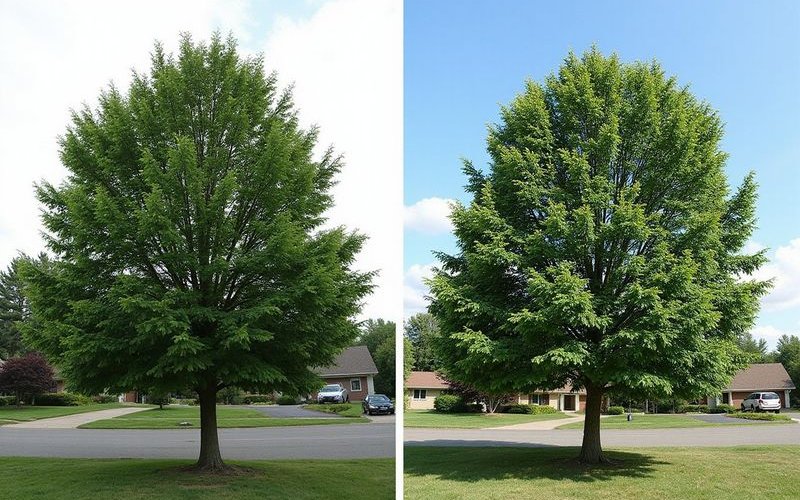
Crown thinning is the selective removal of branches throughout the canopy to reduce its density. The goal is to increase light penetration and air movement through the crown while maintaining the tree’s natural shape and size. Done correctly, a thinned tree should look like a lighter, more open version of itself, not a different shape or smaller tree.
During crown thinning, an arborist removes:
- Small to medium interior branches that contribute to excessive density
- Branches that are crossing, rubbing, or growing toward the interior of the canopy
- Weak, poorly attached branches that are prone to failure
- Water sprouts and suckers that clutter the canopy
- Dead and dying branches throughout the crown
The key principle of proper crown thinning is that it is selective and distributed evenly throughout the canopy. No more than 15 to 25 percent of the live canopy should be removed in a single session. Removing more than that stresses the tree and can trigger the same kind of vigorous, weakly attached regrowth that tree topping causes.
When Crown Thinning Is the Right Choice
Crown thinning is appropriate when you want to achieve one or more of the following objectives:
Improve light penetration. Dense canopies block sunlight from reaching your lawn, garden beds, and lower-story plantings. In Duluth, where the growing season is already short and daylight hours are limited in winter, maximizing available light for understory plants can make a meaningful difference. Thinning allows dappled sunlight to reach the ground without removing the tree’s shade entirely.
Reduce wind resistance. This is one of the most practical reasons for crown thinning in the Duluth area. Lake Superior generates powerful winds, and the city’s exposed hilltop and ridgeline properties take the brunt of it. A dense canopy acts like a sail, catching wind and transferring enormous forces to the trunk and root system. Thinning allows wind to pass through the canopy, reducing the wind load and decreasing the likelihood of storm damage. If you have trees in exposed locations, periodic thinning is one of the best things you can do to prepare for winter storms.
Improve air circulation to reduce disease. Several common tree diseases in northern Minnesota thrive in damp, stagnant conditions within dense canopies. Apple scab on crab apples, various leaf spot diseases, and powdery mildew are all exacerbated by poor air circulation. Thinning the canopy allows better airflow, which helps foliage dry more quickly after rain and reduces the moisture that fungal pathogens need to thrive.
Reduce weight on heavy limbs. Individual limbs that are overextended or carrying excessive foliage weight can be selectively thinned to reduce the load. This is different from removing the entire limb and is a conservative approach that preserves the branch while reducing its risk of failure.
Improve the tree’s appearance. A well-thinned tree simply looks better. The canopy appears lighter and more graceful, and the structural framework of the trunk and major limbs becomes visible, which adds visual interest.
The “Lion’s Tailing” Warning
We often see a specific mistake made by inexperienced trimmers known as “lion’s tailing.” This happens when an improper amount of interior foliage is stripped away, leaving tufts of leaves only at the very ends of the branches.
This practice is dangerous because it shifts the weight to the tips of the limbs. Instead of making the branch safer, lion’s tailing actually increases the leverage the wind has on the branch, making it more likely to snap during a Lake Superior gale. Our arborists strictly follow ANSI A300 standards to ensure weight is evenly distributed along the limb structure.
What Is Crown Raising?
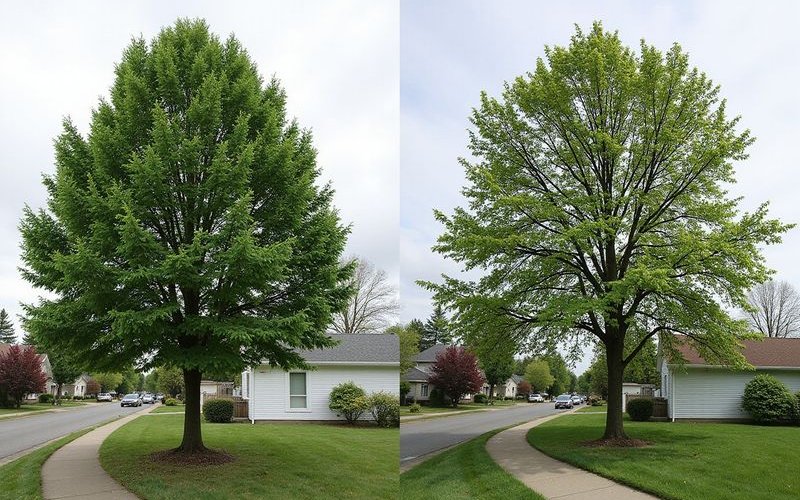
Crown raising, also called crown lifting, is the removal of lower branches to increase the clearance between the ground and the bottom of the canopy. Unlike thinning, which works throughout the entire crown, raising focuses exclusively on the lower portion.
Crown raising is one of the most straightforward pruning operations. The arborist removes entire lower branches back to the trunk, starting from the bottom and working up to the desired clearance height. The cuts are made just outside the branch collar, which is the swollen area where the branch meets the trunk, to promote proper wound closure.
When Crown Raising Is the Right Choice
Crown raising serves a different set of practical purposes than thinning:
Pedestrian and vehicle clearance. Municipal codes and practical necessity require certain clearance heights over sidewalks, driveways, and streets. In Duluth, low-hanging branches over sidewalks can be a hazard for pedestrians, and branches over driveways need to clear vehicles. Typical clearance targets are 8 feet over sidewalks and 14 feet over streets, though these can vary by location and municipality.
Structure clearance. Branches that touch or overhang your roof, siding, or gutters cause physical damage and provide pathways for moisture and pests. Raising the crown to establish clearance from structures is a common and important maintenance task. In Duluth’s older neighborhoods, where homes were often built before nearby trees reached maturity, this is one of the most frequent reasons homeowners call for tree trimming.
Sight line improvement. Low branches can obstruct views, which matters both for safety at intersections and for aesthetics. On Duluth’s hillside, many homeowners value their Lake Superior views and request crown raising to preserve sight lines while keeping the tree.
Lawn and garden access. Low-hanging branches make it difficult to mow, garden, and use the space beneath the tree. Raising the crown opens up usable space while maintaining the tree’s shade and visual presence above.
Security and lighting. Low-hanging branches can block exterior lighting and create concealed areas near buildings. Raising the crown improves visibility around your home and allows security lighting to function effectively.
Important Limitations of Crown Raising
There are important limits to how much crown raising is appropriate. A general rule is that at least two-thirds of the tree’s total height should remain as live canopy after raising. For a 30-foot tree, that means the lowest live branches should be no higher than 10 feet. Raising the crown too aggressively creates a lollipop appearance and shifts the tree’s center of gravity upward, which can actually increase its vulnerability to windthrow.
For young trees, crown raising should be done gradually over several years rather than all at once. Temporary lower branches actually help young trees develop trunk taper and strength. Removing all lower branches at once from a young tree can result in a weak, spindly trunk.
Crown Thinning vs. Crown Raising: A Quick Comparison
We find that seeing the differences side-by-side helps homeowners visualize the right service. This table breaks down the primary goals and results of each technique.
| Feature | Crown Thinning | Crown Raising |
|---|---|---|
| Primary Goal | Reduce density and weight throughout the entire tree. | Create vertical clearance under the tree. |
| Visual Result | A lighter, more open canopy that retains its size. | A higher canopy that exposes the trunk. |
| Best For | Storm prep, light penetration, and disease prevention. | Sidewalks, driveways, views, and mowing access. |
| Key Risk | Lion’s tailing (removing too much inner foliage). | Top-heavy instability (removing too many lower limbs). |
Can You Need Both?
Absolutely. It is common for a tree in Duluth to benefit from both crown thinning and crown raising at the same time. A mature maple in an older neighborhood might need its lower branches raised for clearance over the sidewalk and driveway while also needing the interior of the canopy thinned to reduce wind resistance and improve light penetration.
When both techniques are performed together, the total amount of live canopy removed should still not exceed 25 percent. A skilled arborist will balance the two types of cuts to achieve the desired objectives without over-stressing the tree.
Species-Specific Considerations in Duluth
Different tree species respond differently to thinning and raising, and the right approach depends partly on what you are working with.
Maples respond well to both thinning and raising. Sugar maple and red maple have dense canopies that benefit significantly from thinning every few years. Their naturally spreading form makes crown raising straightforward.
Oaks generally have more open canopies and may not need thinning as frequently. They respond well to crown raising. Remember that oak pruning in Minnesota should only be done during the dormant season from November through March to prevent oak wilt infection.
Birch are best thinned conservatively. Paper birch in particular can be stressed by excessive pruning. Focus on deadwood removal and light thinning rather than aggressive canopy reduction.
Pines and spruce do not generally benefit from crown thinning because they do not produce new growth on old wood the way deciduous trees do. However, raising the crown by removing lower branches is a common and appropriate practice for mature conifers, especially white pines that have outgrown their lower branch clearance.
Ash trees benefit from both techniques, but given the emerald ash borer threat in the Duluth area, discuss with your arborist whether investing in pruning is worthwhile or whether removal is the more practical long-term decision.
How Much Does Crown Thinning and Raising Cost?
Pricing for crown thinning and raising in Duluth depends on the tree’s size, species, location, and the amount of work needed. As of 2026, general industry averages for tree trimming in the U.S. range between $430 and $640 per tree, though local factors will influence your final quote.
Here is a general guide for what to expect:
- Crown raising on a medium tree (25 to 50 feet): $250 to $600
- Crown thinning on a medium tree: $300 to $800
- Combined thinning and raising: $400 to $1,000
- Large trees (50 to 80 feet): $600 to $1,500 or more depending on access and scope
These are rough estimates. The best way to get an accurate price is to have a certified arborist evaluate your specific trees. We provide free estimates for all tree trimming and pruning work in the Duluth area.
Making the Right Decision for Your Trees
The best approach to deciding between crown thinning, crown raising, or both is to start with a clear understanding of what you want to achieve. Are you concerned about storm damage? Thinning is likely the priority. Need more clearance for walking, driving, or mowing? Raising is the answer. Want better light for your garden and less dense shade? Thinning will help. Branches scraping your roof? Raising will solve it.
An ISA Certified Arborist can evaluate your trees, understand your goals, and recommend the right combination of techniques. At Northshore Tree Service, we take the time to explain our recommendations so you understand exactly what we are doing and why. Every pruning plan is customized for the individual tree, its species, its condition, and its environment on your Duluth property.
Contact us today for a free assessment and let our team develop a pruning plan that keeps your trees healthy, safe, and beautiful.
Need Professional Tree Service?
Call our ISA Certified Arborist for a free estimate. Serving Duluth, MN and the North Shore.
Call (218) 555-0391