After the Storm: A Homeowner's Tree Safety Checklist
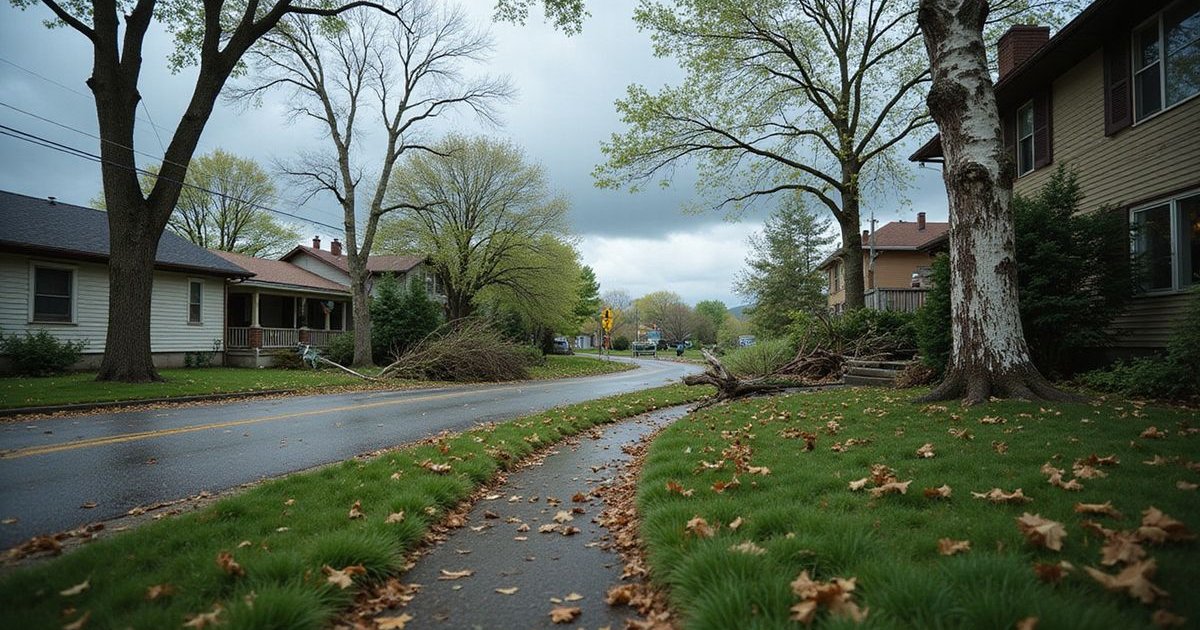
Duluth is no stranger to severe weather. We know the heavy silence that settles over a neighborhood after a Lake Superior nor’easter or a summer derecho passes through. Whether it is an October ice storm or a blizzard dropping heavy wet snow, our local trees take a significant beating.
After a major event, the instinct to rush outside and survey the damage is strong. That reaction is natural. But how you handle those first few minutes determines your safety and the long-term health of your property.
We have created this checklist to guide you through a systematic, safe evaluation of your trees. Print this guide out. You might also bookmark it on your phone or tape it inside your utility closet so it is accessible the moment you need it.
Before You Step Outside: Safety First
You must take specific precautions before walking your property. Storm-damaged trees create some of the most dangerous environments in the arboriculture industry. The hazards are often invisible to the untrained eye.
Check for Downed Power Lines
This is the single most critical step in your assessment. Look out your windows before you even open the door. If you spot any downed wires, do not go outside.
We cannot stress this enough: stay inside if you see lines touching the ground or draped over trees. Call 911 and Minnesota Power immediately. The Electrical Safety Foundation International (ESFI) warns that the ground around a downed line can be energized up to 35 feet away. A downed line can energize the tree it touches and even nearby puddles.
People have lost their lives stepping on ground that appeared safe but was energized by a distant wire. Even if the lines look dead, you must treat them as live. Wires are easily hidden under piles of debris or tangled in canopies where you cannot see them. If your power is out, assume any damaged tree near the street could be hiding a live wire.
Assess Structural Damage to Your Home
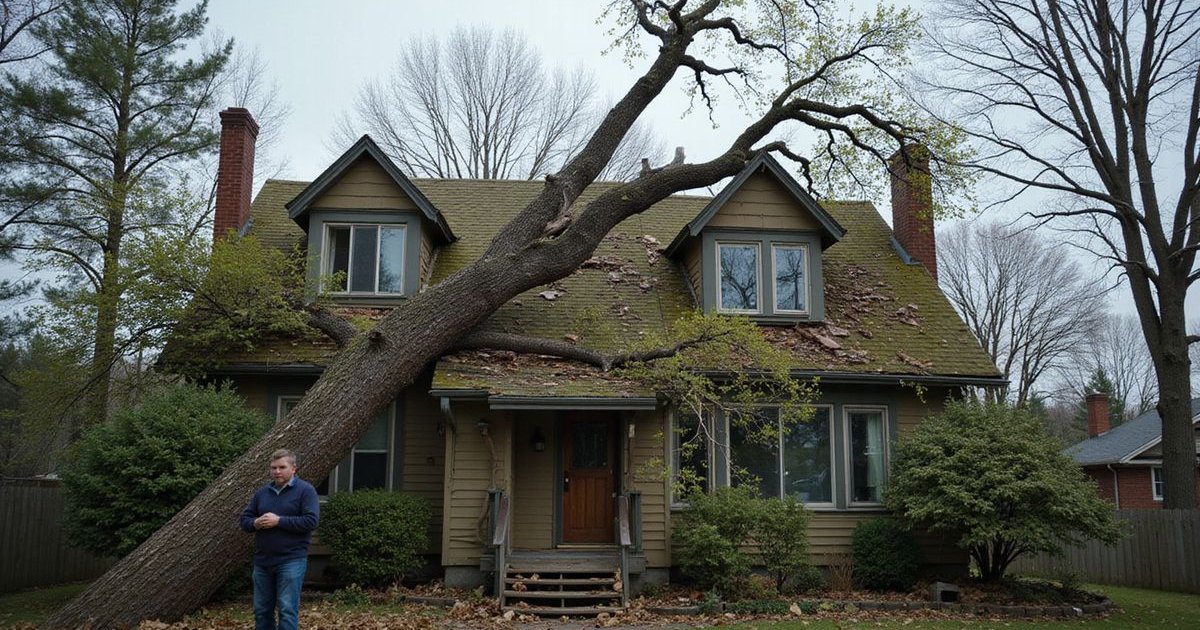
Your home’s stability takes priority over the trees. If a tree has impacted your house, do not enter that section of the building until you verify it is stable.
We recommend looking for specific indicators of structural failure from a safe distance. Sagging rooflines, exterior cracks wider than 1/4 inch, or shifted foundations are major red flags. If you see broken windows or bowed walls, stay out and contact emergency services.
Tree removal and structural repair must be coordinated carefully in these scenarios. Our guide on filing an insurance claim for tree damage details the exact sequence of events you need to follow.
Watch Where You Walk
Post-storm ground conditions are treacherous. We often find the ground littered with sharp branch stubs, glass, and construction debris like nails.
Wear boots with puncture-resistant soles, heavy pants, and leather gloves. You need protection from tripping hazards hidden under layers of leaves. If the storm involved ice, remember that your driveway may be a skating rink.
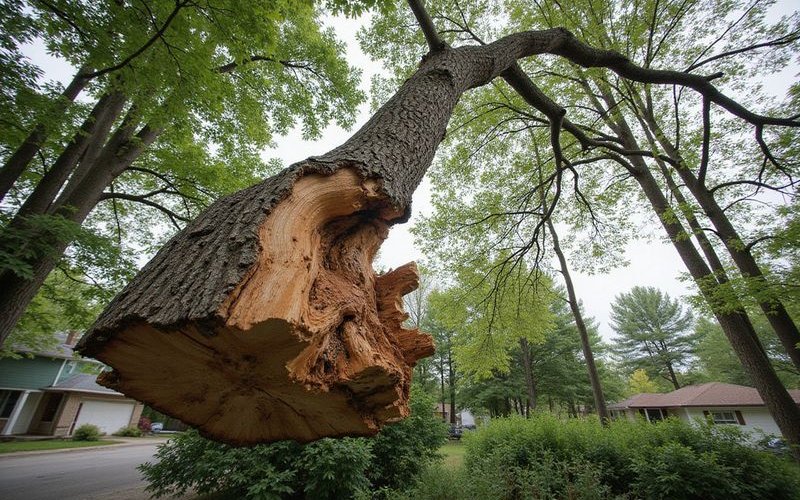
The Post-Storm Tree Assessment Checklist
Once you are certain the area is safe, you can begin your inspection. We suggest working in a circle, starting with trees closest to your house and moving outward.
1. Look Up: Check for Hanging Branches
You must look up into the canopy before you approach the trunk. Hanging branches, known in the industry as “widowmakers,” are detached limbs caught in the upper crown.
We see these fall without warning days after a storm ends. A gust of wind or even the vibration of a squirrel can dislodge a limb weighing hundreds of pounds. If you spot a hanger, do not walk under it.
Mark off the drop zone with caution tape or orange cones immediately. You must keep children and pets away from this area until a professional handles the removal.
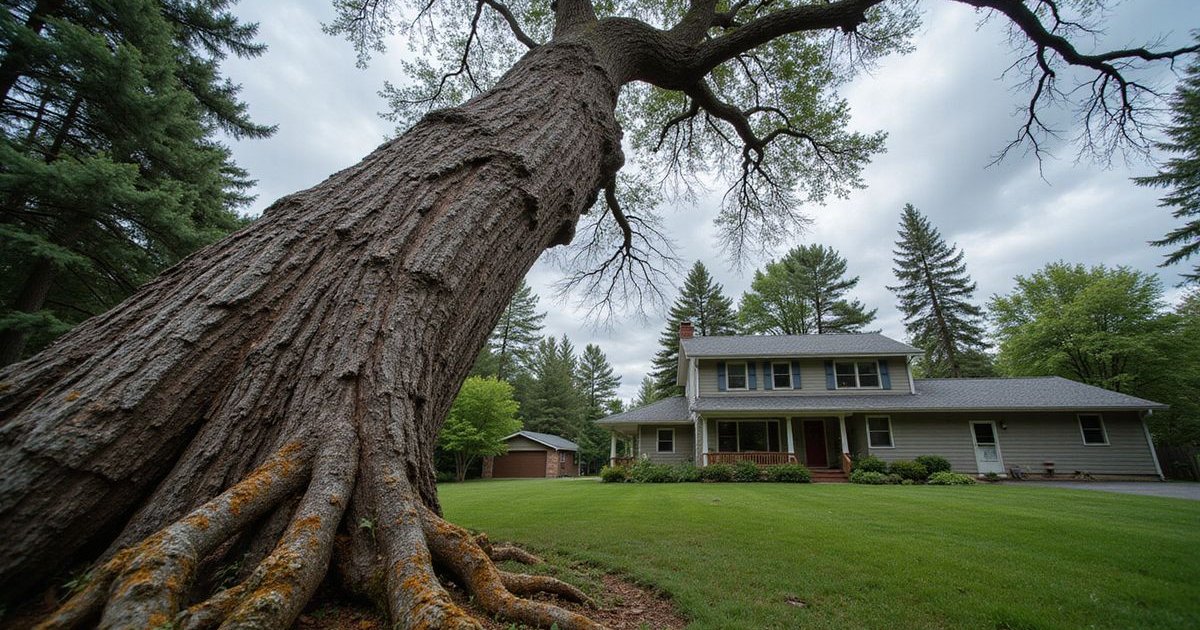
2. Check for Leaning Trees
Walk a full circle around each tree to check its vertical alignment. You are looking for any new lean compared to your memory of the tree or nearby trees.
We consider a new lean of greater than 15 degrees to be a critical failure risk. This often indicates root plate failure, meaning the roots have snapped or pulled loose. Look closely at the base of the tree on the side opposite the lean.
You might see “soil heaving,” where the ground lifts up, or fresh cracks in the soil. If you spot exposed roots on the upwind side, that tree is an emergency. Stay clear of the fall zone and contact our emergency tree service team.
Duluth’s clay soils saturate quickly during heavy rains. This saturation acts like a lubricant, significantly reducing the soil’s ability to hold root systems in place on our hillsides.
3. Examine Trunks for Splits and Cracks
Scan the trunk for any vertical openings. You are looking for fresh, light-colored wood inside cracks or areas where bark has twisted off.
We treat deep cracks that extend into the wood tissue as severe structural defects. If the crack goes beyond the bark, the tree is at risk of splitting apart.
Codominant stems, where the trunk splits into two large Vs, are common failure points. If you see a gap opening between these stems, the tree is unstable. These failures can happen instantly.
4. Assess Canopy Damage
You need to estimate the percentage of branches lost. This math helps decide the tree’s future.
| Canopy Loss | Prognosis | Recommended Action |
|---|---|---|
| Under 25% | Good | Corrective pruning to clean jagged wounds. |
| 25% - 50% | Uncertain | Requires professional assessment. Recovery takes years. |
| Over 50% | Poor | Structural integrity is likely gone. Removal is usually necessary. |
Less than 25 percent canopy loss: The tree will likely survive. We can help it recover with clean pruning cuts that allow the tree to seal its wounds.
25 to 50 percent canopy loss: Recovery depends on the species and age. Vigorous trees like maples may bounce back, while pines often struggle.
More than 50 percent canopy loss: The tree has lost its ability to photosynthesize effectively. We usually recommend removal because the large wounds will invite decay before the tree can recover. You can read more about these decisions in our article on signs that a tree should be removed.
5. Check for Broken Tops
Look for the main leader of the tree to be snapped off. We see this frequently with Spruce and Balsam Fir trees in our region.
A broken top opens the heart of the tree to immediate rot. While the tree might stay green for a while, the structure is permanently altered. Decay moves downward rapidly from a topped break, creating a hollow column over time.
6. Look for Root Plate Lifting
Inspect the ground where the trunk meets the soil. Root plate lifting happens when the wind pushes the tree hard enough to lift the root ball without snapping the trunk.
We look for a “mound and pit” effect. You will see soil mounded on the side the wind came from and a depression on the opposite side. If the tree is rocking in the wind, the root plate is detached. This requires a professional opinion immediately.
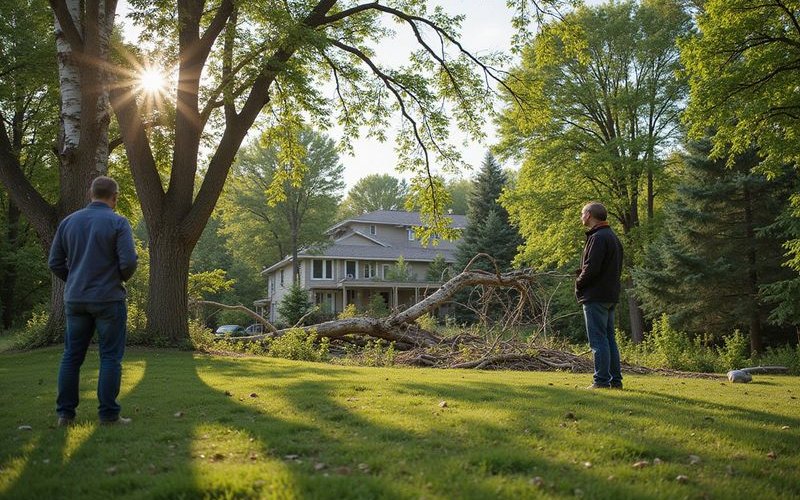
7. Document Damage for Insurance
You should document every detail before moving any debris. Take clear photos and videos from multiple distances.
We recommend getting wide shots that show the tree in relation to your house, as well as close-ups of the specific breaks. This visual evidence is vital for your insurance claim. Most policies cover damage that is “sudden and accidental,” and your photos prove the timeline.
Write down the date and time of your inspection. Your insurance adjuster will cross-reference this with weather reports to validate the claim.
What NOT to Do After a Storm
Bad decisions after a storm cause more injuries than the storm itself. The Centers for Disease Control (CDC) reports roughly 36,000 chainsaw-related injuries annually, many occurring during post-disaster cleanup.
Do not attempt to cut trees under tension. Storm-damaged trees are like loaded springs. We call this “stored energy.” A branch pinned under a trunk can snap upward with thousands of pounds of force when cut. This reaction can be lethal. Our article on DIY vs professional tree removal outlines why tension is the enemy of the DIYer.
Do not climb a damaged tree. You cannot trust the branch attachments. Internal cracks are often invisible from the ground. A limb that held your weight yesterday might snap today.
Do not touch trees near utility structures. This is strictly for line-clearance qualified arborists.
Do not rush the process. Most tree work can wait. Unless a tree is actively crushing your roof or blocking your only exit, take a breath. We see services overwhelmed after storms. Patience saves you from making a hasty, dangerous mistake.
Do not hire uninsured operators. Storms bring out “storm chasers” with pickup trucks and chainsaws. These operators often lack General Liability and Workers’ Compensation insurance. If they drop a limb on your roof or get hurt on your land, you are the one liable for the costs.
When to Call a Professional Immediately
Some situations require urgent intervention. We prioritize these scenarios to protect lives and property:
- Structural Impact: A tree is resting on your home, garage, or car.
- Imminent Failure: A tree is leaning significantly toward a structure.
- Electrical Hazard: Branches are tangled in power lines (Call the utility company first).
- Overhead Danger: Large broken limbs are hanging directly over driveways or paths.
- Split Trunks: The main stem has cracked but not yet separated.
- Access Blocked: You cannot leave your property due to debris.
For these critical issues, contact an emergency storm damage service immediately. Our team at Northshore Tree Service is equipped to handle these high-risk removals safely and efficiently.
After the Cleanup: Long-Term Recovery
Your trees need help to adjust after the initial danger has passed. We focus on stabilizing the remaining canopy to prevent future decline.
Schedule corrective pruning. Rough tears from storm damage do not seal well. We come in to make clean cuts at the branch collar, which allows the tree’s natural defense system to wall off decay. This should happen within a few weeks of the event.
Monitor for stress signals. You should watch your trees closely over the next two growing seasons. Look for canopy dieback or early leaf drop. These are signs the tree is struggling to cope with the root or canopy loss.
Plan for future resilience. Storms expose weak points in your landscape. We can use this information to improve your pruning schedule. A well-thinned canopy allows wind to pass through rather than pushing the tree over. Our winter storm preparation guide offers proactive steps for the next season.
Be Ready Before the Next Storm
Duluth weather is unpredictable, but your preparation does not have to be. We find that trees maintained by certified arborists consistently survive storms better than neglected ones.
At Northshore Tree Service, we are your partners in weathering the storm. Contact us today for a full property assessment. We will help you ensure your trees are ready for whatever Lake Superior sends our way.
Need Professional Tree Service?
Call our ISA Certified Arborist for a free estimate. Serving Duluth, MN and the North Shore.
Call (218) 555-0391